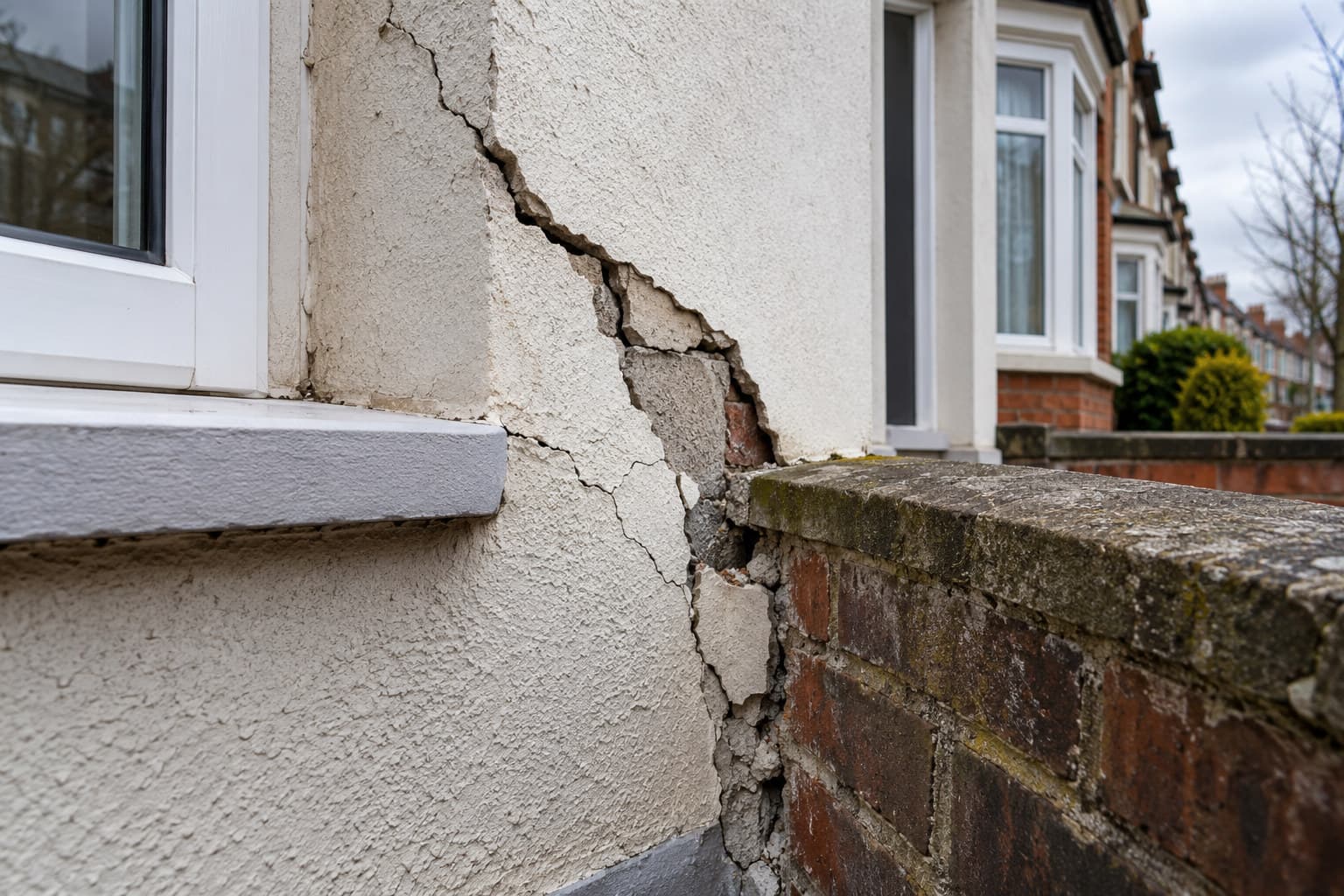
If your neighbour’s builder has damaged your property, the single most useful thing you can do right now is photograph the damage clearly and in a way you can date, before it gets cleaned up, patched over, or repainted.
Why the photo matters more than the argument
When a neighbour’s building work damages your property, the natural instinct is to go round and have the conversation straight away. That conversation matters, but it does not survive on its own. What survives is the record. A crack, a stain, a cracked fence panel, a damaged drain, a scuffed boundary wall: all of it can be repaired, repainted, or simply forgotten within days, especially if the builder is still on site and keen to tidy up before anyone looks too closely.
You are not trying to catch anyone out. You are trying to make sure that if this does need to be resolved later, whether through the neighbour, their builder, or a formal process, there is a dated, clear account of what the damage looked like at the time. Without that, you are relying on memory and goodwill. With it, you have something concrete to point to.
What to photograph, and how
- Photograph the damage itself close up, in focus, with enough light to show real detail.
- Photograph it again from further back so it is clear exactly where on your property it sits.
- Circle or mark the exact defect in a second shot if it is not obvious from the photo alone.
- Note the date, and ideally photograph a newspaper, phone screen showing the date, or similar if you want an extra layer of certainty.
- Photograph any related damage too, not just the obvious one: a cracked pipe can mean a stained ceiling, a damaged fence can mean disturbed ground either side.
If the damage is affecting several areas, a written description read aloud as you walk round and photograph each item is far more useful later than a scattered set of images with no context. This is exactly the gap a tool like SayScope is built for: you photograph each defect, circle it on the photo, hold a button and say what is wrong, and you leave with a report grouped by room and by trade, so the record is organised from the start rather than needing to be reconstructed later.
What this is, and what it is not
This article is general information, not legal advice, and any court material below relates to England and Wales. Nothing here tells you what a court, an adjudicator, or a builder will do in your situation. The law that applies, and how it applies, depends on the facts.
Where a contract claim might sit, if there is one
If you had a direct contract with the builder yourself, for example if you commissioned the work or it also covered your property, the Consumer Rights Act 2015 may be relevant. Section 49 treats every contract to supply a service as including a term that the trader performs it with reasonable care and skill. Section 55 gives the consumer the right to require the service to be performed again to complete it properly, within a reasonable time and without significant inconvenience, with the trader bearing the necessary costs, unless completing it properly is impossible. Section 56 allows the consumer to require a price reduction where repeat performance is not available or has not happened within a reasonable time and without significant inconvenience, with any refund due paid without undue delay and in any event within 14 days of the trader agreeing the consumer is entitled to it, by the same payment method, with no fee charged.
Where there is no contract between you and the builder, because the contract sits between your neighbour and their builder, these rights do not automatically transfer to you simply because your property was affected. This is a genuine gap, and it is worth being clear-eyed about it rather than assuming the Consumer Rights Act covers a situation it does not.
The Limitation Act 1980, section 5, sets a six year limit for bringing an action founded on simple contract, counted from when the cause of action accrued. This is a backstop on how long a contract claim can wait, not a reason to delay.
If it ends up in a small claim
Claims of this kind, where they proceed at all, often sit within the small claims track covered by Civil Procedure Rules Part 27, which generally applies to claims not exceeding £10,000. Under rule 27.5, no expert may give evidence, written or oral, at a hearing without the court’s permission. Standard directions require each party to file and serve copies of all documents they intend to rely on at least 14 days before the final hearing. The strict rules of evidence do not apply and the court does not need to take evidence on oath.
What this means practically is that your photographs, dated and organised, are likely to be among the documents you would want to have ready well in advance, not assembled at the last minute.
What to do while the builder is still on site
- 1Photograph and describe every piece of damage you can see, before anything is repaired or tidied.
- 2Keep the originals, with their date and time metadata intact, rather than only keeping edited or cropped copies.
- 3Note down what was said to you by the neighbour or builder, and when, in your own words, as soon as possible after the conversation.
- 4Avoid agreeing to any quick fix before you have a full record, since a hasty patch can make it harder to show the original extent of the damage.
- 5Keep a simple log of dates: when the damage was first noticed, when it was raised, and what happened next.